
River’s ‘studio’ is straight-up the kind of place my parents warned me about. They’d tell me that they didn’t immigrate to Canada so I could hang out at grow ops on the rez without cell service. Yet last week I parked my car beside a cornfield, said goodbye for what I hoped was not the last time, and started walking down an ancient stone fence marking the edge of said cornfield.
You can’t be under forty and grow up in Canada without knowing at least a little bit about our treatment of indigenous people. I knew that there was a large and varied population of indigenous people before Europeans arrived, that the relationship started out alright, but before long there were cutthroat strategies being employed to exterminate indigenous culture, if not indigenous people. But I don’t think I’ve ever been on a reservation or even met an indigenous person in real life. If I did they had very intentionally left the reserve for the city.
As I understand it this is one of the better reserves in Canada to live on. The landscape is limestone scrubland, many houses are dilapidated, clearly a lot of people live and work here but aside from a concentration of cheap gas stations and grey-market dispensaries there doesn’t appear to be a centre to the community. People just seemed to come and go, mostly on four-wheelers, from a huge variety of homes often set back in the forest. It reminded me of a modern version of an old west town, and not in a good way. I guess the water is technically fine to drink but River still boils hers: environmental and drinking water regulations are provincial matters and this is federal jurisdiction. But it sounds like the feds keep their distance too, many see this as sovereign land and nobody wants trouble.
Ever since I moved here I’ve been fascinated by how many private roads wind their way deep into farms and forests to various buildings. These would have been completely invisible to all but local pilots until the advent of satellite maps on the internet. Now I can view all my neighbour’s secrets from my computer, and they have a lot of secrets. River’s place is along one such road. I walked along the cornfield, then another, and finally met a rutted track leading into the forest where I was attacked by giant swarms of mosquitoes. Then, after an hour of walking that ruined my white chinos, I came to a sun-baked clearing.
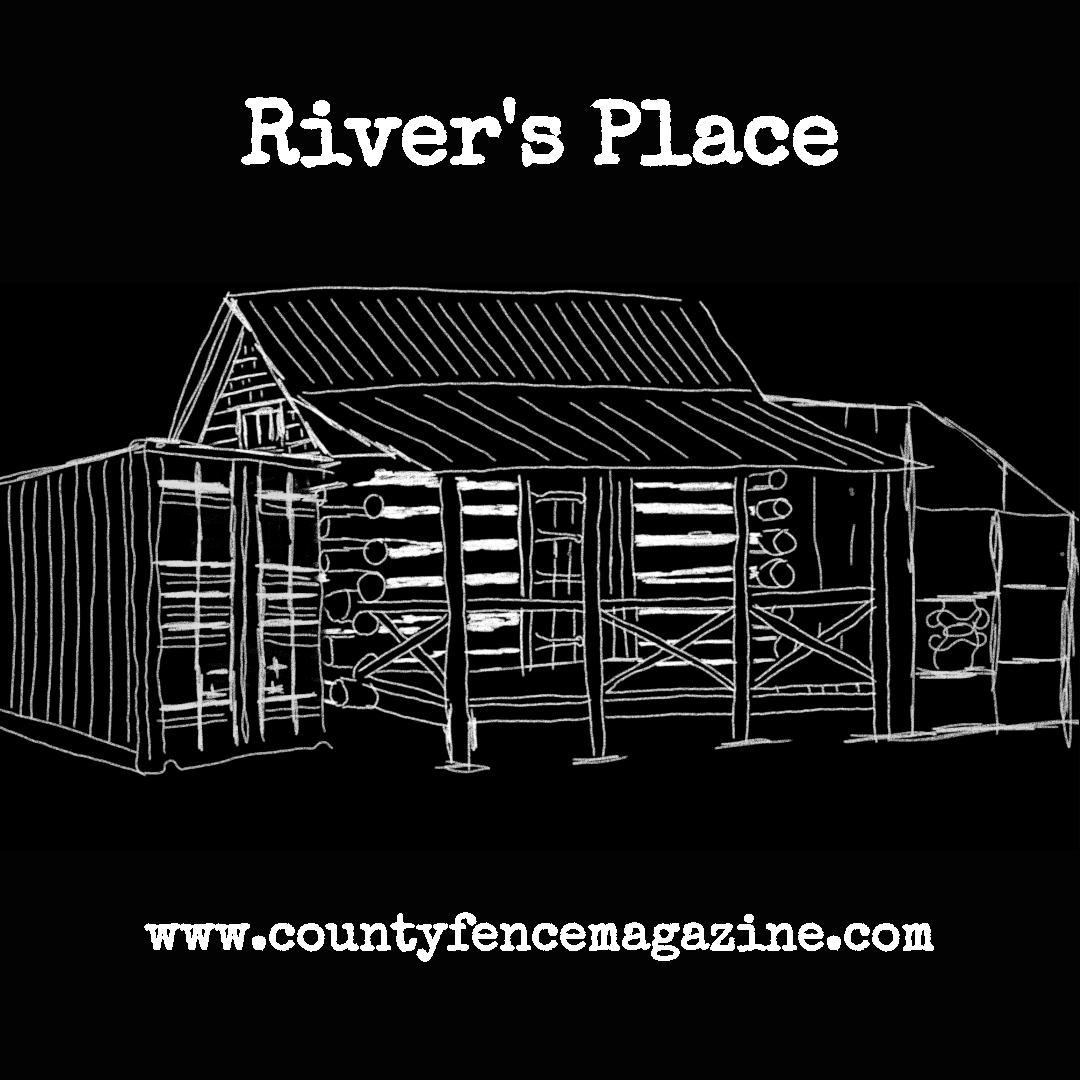
River lives in a 1970’s travel trailer that has obviously not moved in a very long time, it’s painted over in a vivid indigenous beadwork motif. In the centre of the clearing is a giant fire pit with various log seating around it ranging from plain logs to skillfully sculpted timber furniture. On the far side is River’s studio: a log structure shored up on one side by a shipping container and on the other by a greenhouse. Yet this wasn’t my first impression.
When I emerged from the woods a snarling pit-bull appeared out of nowhere and came running at me, barking and slobbering. Just as I was envisioning being torn apart by some forest dog I heard a whistle, a command for the dog to stand down, and when it didn’t a large bang that caused it to stop in its tracks. When I opened my eyes the dog was sitting, vibrating with energy, staring at me and bearing its teeth just a few feet away. On the far side of the clearing was a woman in her thirties wearing a pair of paint-splattered painter’s overalls and cheap neon wayfarers. She was looking at me over the sunglasses, holding the biggest shotgun I’ve ever seen.
“You’re an hour late,” she said.
“My car wouldn’t make it down the trail, I had to walk” I replied.
“Sounds like you’ve got the wrong car.”
I didn’t know what to say and wasn’t going to test the limits of the dog’s training so I stayed in my spot as she approached, leisurely, studying me the whole way. When she reached the dog she gave it a pat, said something quietly, and it disappeared into the woods just as fast as it had materialized. As she got closer I realized she might be the most beautiful woman I have ever seen.
“So Jules sent you, huh?”
“Yeah, how do you know Jules?”
“Anyone who matters knows Jules.”
“You’re the first person I’ve met who has any idea who he is.”
“Then I’m the first person you’ve met who matters.”
Holy shit. I love this woman.
Inside the cobbled-together studio I found the primary reason for the shotgun: to the right there was a small greenhouse full of absolutely gorgeous cannabis plants. Like so many engaging in agricultural endeavours on land of questionable sovereignty the legality was equally questionable. Security was more of a DIY matter. Apparently art alone doesn’t pay the bills but a small patch of the good stuff could, and River’s is definitely the good stuff. The centre of the building housed a few work tables and a kitchen, River’s baking is otherworldly, and she had built a bright and airy studio space in the shipping container. On the back of the building there was a small screened porch, where she obviously spent most of her time, and one of those easy-set pools. She flopped down in an old glider-rocker covered in blankets to hide the threadbare upholstery next to a giant pile of books and I got comfortable in a folding camp chair.
River’s art is diverse. She’s an accomplished painter, currently working on a novel, a top notch wood carver, and handy with a chainsaw. She’s also dabbled in beadwork and other traditional indigenous crafts. Indigenous culture has been so thoroughly and systematically destroyed that she has dedicated her life to rebuilding it, regardless of the cost. Holy shit.
I knew that one people with a highly structured society, gunpowder, and the ability to cross oceans systematically oppressed the tribal hunter-gatherer societies they found on the other side. I also knew that these hunter-gatherer societies were far more developed and nuanced than those hierarchical colonial thinkers assumed and the majority of Canadians are only now accepting this. What I did not know is that the local indigenous people are not indigenous to this area: the original inhabitants were moved elsewhere to make way for this group who fought as loyalists in the American Revolution. River has a print of the treaty between this group and the crown tacked to the wall of her studio as a reminder that within five years the crown reneged on the treaty and took back eighty percent of the land they had promised to these brothers in arms. This is a contributing factor to low real estate prices surrounding the reserve as buyers lack confidence in their legal claim to land so clearly belonging to the reserve. After that came the residential schools.
River’s work is a mix of modern and traditional that I really like. You know how I feel about Cornelius Crieghoff and his fans. River tackles some of the same subject matter with far more nuance and reality. She also paints dream-punk pictures of what she hopes the future might hold. In a lot of ways she’s not making art, she’s making a new world and that world is so new the only thing to do is make inspiring pictures about it so that other people might be inspired and take up her cause.
It’s hard for me to envision the healthy future River is imagining. As an immigrant, I’ve never felt like I had a dog in this fight. My parents moved here before Hong Kong was returned to China and it’s always just felt like a place to live. I only moved to Brownlow because of housing prices. Yet today I realized that in a lot of ways I’m one more in a long line of people migrating here. The clock cannot be turned back, the harm cannot be undone, and the stream of immigrants cannot be blocked. We’re all just people migrating around looking for the most hospitable place we can find to grow our lives in, and it feels like an unstoppable wave. We certainly haven’t been able to stop it yet.
-Walter